English
Search

2026/09/18
As of September 17, the international dry bulk market continued to diverge. The Baltic Dry Index (BDI) stood at 3,336 points, down 171 points from the previous week.
Capesize and Panamax markets weakened markedly, while Supramax and Handysize rates continued to rise. The main pressure remains concentrated in the large-vessel segments, while rates for smaller vessels continue to receive support from regional cargo demand.
Capesize rates have recently retreated from their highs. On September 17, the Baltic Capesize Index (BCI) stood at 5,656 points, down 424 points from the previous week and representing the main drag on the BDI.
Capesize fundamentals had previously remained relatively strong.
Signal data show that Capesize tonne-mile demand rose 7.9% year on year in early September, while available capacity fell 1.8%. The demand-to-supply indicator reached 1.10, making Capesize the only one of the four main dry bulk vessel segments with a reading above 1. The global Capesize ballast fleet comprised about 604 vessels, with the largest concentration in Australasia.
The recent rate correction mainly reflects a cooling market after the earlier rapid increase. The outlook will continue to depend on iron ore shipments from Brazil and Australia, as well as changes in vessel availability in the Atlantic and Pacific.
Panamax underperformed the other vessel segments. On September 17, the Baltic Panamax Index (BPI) fell to 2,282 points, down 125 points from the previous week.
The main pressure on this segment currently comes from cargo demand. Signal data show that Panamax tonne-mile demand fell 6.9% year on year in early September, while available capacity increased 2.1%. The demand-to-supply indicator dropped to 0.91, showing that capacity grew faster than transport demand.
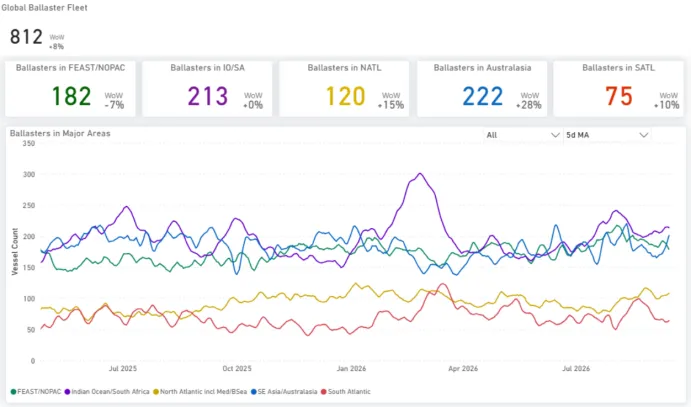
Panamax Vessels - Global Ballast Fleet and Regional Distribution (Source: Signal)
Slower Chinese thermal coal imports have had some impact on the Pacific market. China's seaborne thermal coal flows fell 12.1% year on year in July and 17.1% in August. Volumes from Indonesia to China declined 18.2% and 35.7%, respectively. Indonesia's share of Chinese thermal coal imports also fell from 65.2% in the same period last year to 55.2%.
The International Energy Agency (IEA) expects China's seaborne thermal coal imports to total about 310 million tonnes in 2026, down 4.6% year on year. Heating and restocking demand may increase during the autumn and winter, while imported coal prices, domestic coal production, and power plant inventories will determine the strength of subsequent seaborne purchases.
Supramax and Handysize continued to outperform the large-vessel segments. On September 17, the Baltic Supramax Index (BSI) stood at 1,762 points, up 43 points from the previous week, while the Baltic Handysize Index (BHSI) rose to 980 points, an increase of 40 points.
Supramax rates had previously increased on several routes in the US Gulf, Asia, and West Africa, while Handysize gains were driven mainly by the Atlantic market. These vessel types carry a more diversified mix of cargoes, including grain, coal, fertilizers, and minor ores, and regional trade continues to support freight rates.
The market is clearly split: Capesize and Panamax are retreating, while Supramax and Handysize are rising. Near-term focus will be iron ore shipments, Chinese coal imports, and fourth-quarter grain demand.
This is the first one.