English
Search

2026/05/29
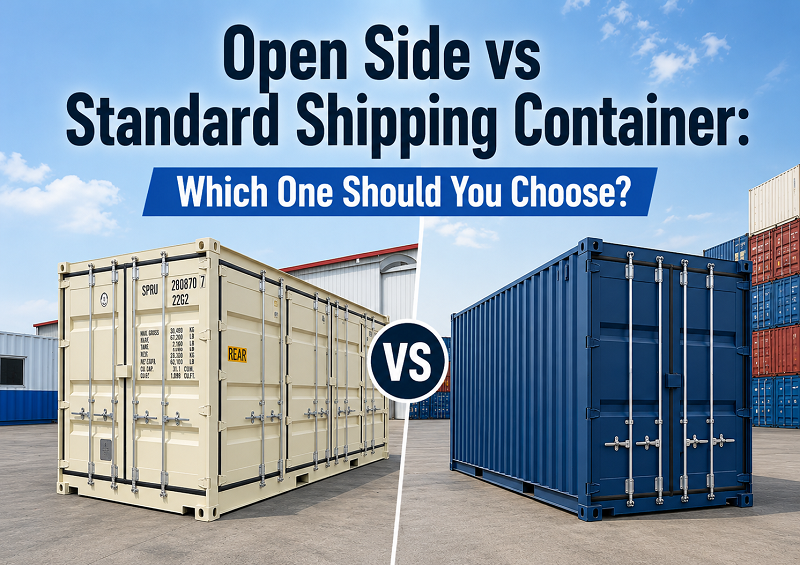
The choice between an open side shipping container and a standard shipping container depends primarily on how you need to access cargo.
If your operation requires frequent loading, side access, oversized items, or retail/workspace conversions, an open side door container often delivers better operational efficiency. If cost, structural simplicity, and conventional cargo transport are the priority, a standard shipping container is usually the more practical choice.
The biggest mistake buyers make is selecting based only on price. A standard container may cost less upfront, but poor accessibility can create daily operational inefficiencies that cost far more over time.
This guide compares both options from a real-world operational perspective—covering loading efficiency, costs, logistics, applications, and when upgrading to an open side model is genuinely worth it.
| Factor | Open Side Container | Standard Shipping Container |
Access Points | Full side opening + end doors | End doors only |
Loading Flexibility | Excellent | Limited |
Oversized Cargo Handling | Better | More restrictive |
Storage Accessibility | High | Lower |
Cost | Higher | More affordable |
Structural Simplicity | More moving parts | Simpler design |
Modification Potential | Excellent | Moderate |
Common Sizes | 20ft & 40ft high cube | All standard sizes |
The core difference comes down to accessibility versus cost efficiency.
A standard container works well when cargo can be loaded from the end. But for operations requiring quick access to inventory or awkwardly shaped materials, an open side configuration can significantly improve workflow.
An open side shipping container is a modified shipping container designed with full-length side doors, allowing access from the side instead of relying only on end doors.
Unlike standard containers, which require cargo to be stacked and unloaded sequentially, an open side door container gives immediate access to the entire interior.
This makes loading and unloading far more efficient.
Typical features include:
Full side-opening access
Standard rear cargo doors
Lockable steel side panels
Weather-resistant sealing
High cube options for extra vertical clearance
Popular options include:
20 open side shipping container
40 ft open side container
These models are commonly used in logistics, retail, warehousing, construction, and industrial applications.
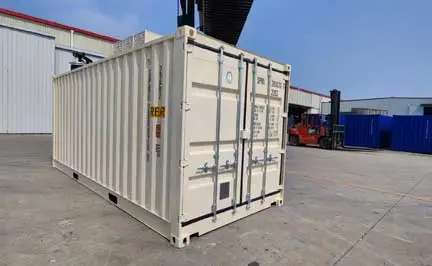
A standard shipping container uses rear-end cargo doors only.
This remains the most common container configuration globally because it is:
Cost-effective
Durable
Easier to source
Suitable for most cargo types
Simpler to maintain
For many businesses, end-door access is sufficient.
However, loading limitations become more noticeable when handling:
Palletized inventory with frequent retrieval
Long materials
Heavy machinery
Retail inventory rotation
Side-loading forklift operations
The lower purchase price can sometimes be offset by reduced operational efficiency.
Paying more for an open side model is justified in several operational situations.
If employees constantly retrieve products from storage, accessibility becomes valuable.
With a standard container:
Front cargo blocks rear access
Reorganization becomes necessary
Time loss increases labor costs
An open side door container allows personnel to access inventory directly from multiple positions.
This is especially useful for:
Warehousing overflow
Spare parts storage
Construction materials
Rental equipment businesses
Large materials often fit poorly through standard rear doors.
Examples include:
Steel pipes
Lumber
Machinery
Exhibition equipment
Industrial components
A 40 ft open side container offers substantially easier loading for long or irregular cargo.
Forklifts can access the full side opening rather than maneuvering through narrow end access.
Open side containers are widely used for:
Pop-up stores
Showrooms
Cafes
Event spaces
Mobile workshops
Why?
Because the side opening creates a natural storefront.
A 40 ft high cube open side container is especially popular for container retail because the added height improves customer comfort and interior usability.
Contractors often prefer side access because tools and materials remain easier to organize.
Instead of stacking everything near the front doors, equipment can be arranged for faster retrieval.
Over months of daily use, this operational convenience becomes meaningful.
Despite the advantages of open side access, standard containers remain the smarter investment in many cases.
Open side models typically cost more.
Why?
Because:
Additional doors increase manufacturing complexity
Structural reinforcements are required
Supply availability is lower
If storage is straightforward, paying extra may offer limited return.
For businesses storing:
Bulk inventory
Seasonal products
Construction supplies
Non-frequently accessed goods
A standard container often works perfectly well.
If items remain inside for weeks or months without movement, side access may not justify the premium.
Standard containers are easier to source, transport, and interchange globally.
For shipping-heavy operations, simplicity matters.
Replacement, repair, and logistics support tend to be easier for standard container configurations.
The right size depends on cargo volume and operational requirements.
A 20 open side shipping container works well for:
Smaller job sites
Compact storage areas
Urban environments
Limited inventory needs
A 20ft high cube open side container adds extra vertical space without increasing footprint.
This is often ideal for:
Equipment storage
Workshop conversions
Retail kiosks
Taller inventory items
A 40 ft open side container suits businesses requiring:
Larger inventory capacity
Extensive side loading
Bulk storage
Long cargo transport
For modification projects, a 40 ft high cube open side container is particularly valuable because:
Ceiling clearance improves usability
Interior feels more spacious
Ventilation and layout options improve
However, larger containers require more space for placement and transportation.
Not necessarily—but maintenance matters more.
An open side configuration introduces:
Additional hinges
More locking systems
Extra seals
These components require periodic inspection.
Maintenance considerations include:
Weather seals should remain tight to prevent water intrusion.
Side doors experience more operational wear.
Lubrication helps extend lifespan.
Security hardware should remain functional, especially for commercial storage.
A properly maintained open side container remains highly durable, but it usually involves more upkeep than a standard design.
This depends entirely on operational efficiency.
If side access saves labor, reduces loading time, or improves inventory management, the premium often pays for itself.
For example:
A warehouse team accessing products daily may save hundreds of labor hours annually through better accessibility.
On the other hand, if the container mainly stores seasonal equipment that rarely moves, the extra investment may produce little return.
Think beyond purchase price.
Ask:
How much operational friction will this container remove?
Choose an open side shipping container if you need:
Faster loading and unloading
Frequent inventory access
Retail or workspace conversion
Side forklift loading
Oversized cargo handling
Choose a standard shipping container if you prioritize:
Lower upfront cost
Simpler maintenance
Basic storage
Standard cargo shipping
Long-term durability with minimal upkeep
In many cases, the best decision is not about buying the most feature-rich option—it is about matching the container to how your business actually operates.
An open side container features full-length side-opening doors, allowing easier access to cargo compared with standard rear-door-only containers.
Yes. Open side models generally cost more because of added structural engineering and lower availability.
A 20ft high cube open side container works well for compact sites needing extra height and improved access, such as workshops, equipment storage, or retail setups.
A 40 ft high cube open side container provides maximum storage space, side access, and additional interior height, making it ideal for commercial conversions and large inventory storage.
Yes, provided the container meets cargo-worthy standards and certification requirements.
Yes. Most include heavy-duty locking systems on both side and rear doors, offering strong security when properly maintained.